
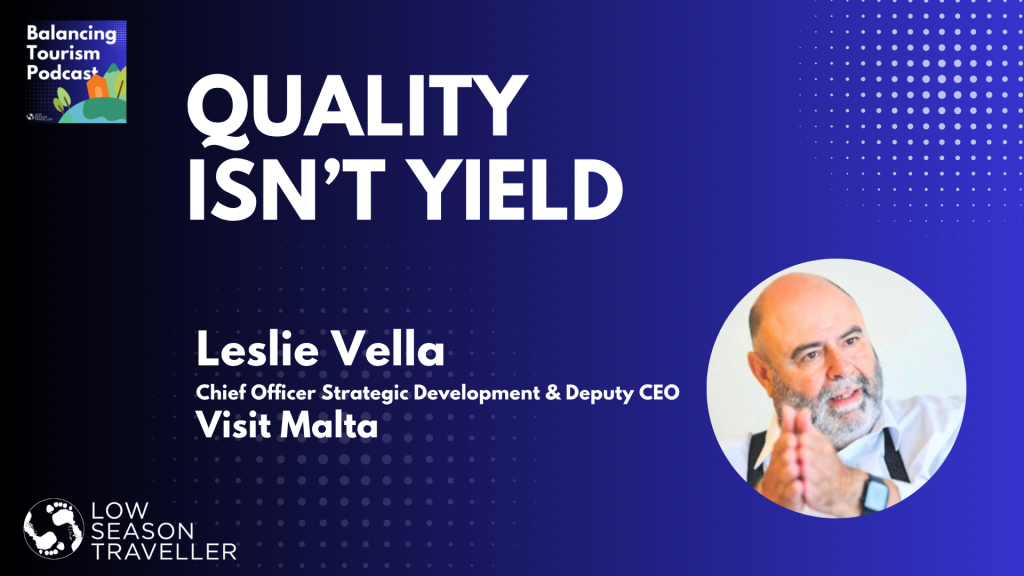
When Leslie Vella joined what is now the Malta Tourism Authority in 1982, his business card had a Telex address and a Telegram address on it. The organisation had fifteen people. Malta received around half a million tourists a year. Eighty percent of them came from the United Kingdom. Almost all of them came in summer. The work, Vella recalls, was largely reactive. You waited for the season to end, conducted a postmortem, and hopefully made a few adjustments for the year ahead.
Forty-three years later, Vella is Chief Officer of Strategic Development and Deputy CEO of the Malta Tourism Authority, Managing Director of the Malta Tourism Observatory, and the architect of the national tourism strategy that will carry Malta to 2035. Malta hit four million tourists last year. The UK now accounts for around 18% of arrivals rather than 80%. The airport handles ten million passenger movements, up from three million a decade ago. Direct flights connect Malta to 110 destinations, including a new Delta service from JFK starting this summer.
That arc is the strategic story most destinations would like to tell about themselves. Few have actually done it.
The shock that started it
Malta’s diversification was not an act of foresight. It was an act of survival. Between 1981 and 1984, arrivals collapsed from around 800,000 to 480,000 in three years, a near-halving driven by the British market alone. Sterling weakened against the Maltese lira, making Malta expensive overnight. At the same time, the destinations Malta had quietly benefited from in the 1970s, when the Mediterranean was dominated by political instability and conflict, came back online. Spain, Greece, Portugal, Cyprus, Egypt, Tunisia and Morocco all reopened for business roughly at once.
What Vella describes as eighteen months of going round in circles ended with three strategic conclusions: diversify geographically, move away from total dependence on summer, and stop competing on price alone. “At that time,” he notes, “if a hotel raised its half-board price by 50p per night, it lost competitiveness to Spain or Tunisia. It was that tight.”
What followed was decades of patient rebuilding into the European mainland, then year-round positioning, then a deliberate move out of the shrinking tour operator charter model and into low-cost carriers and direct sell.
Why being an island nation, not just an island, matters
Vella draws a sharp distinction between Malta and the other big Mediterranean islands. Sicily, Sardinia, Corsica, Mallorca, the Greek islands. They all have a mainland to fall back on. They import labour from the mainland in summer and send it back in winter. When their regional budgets struggle, the national budget supplements them. Malta has no such backstop.
“We have been on our own since independence,” Vella says. “Nobody owes you a living, and you have to go out and get results. That changes your attitude.”
That mindset shows up in unexpected places, including how Malta benchmarks itself. The country has a population of around 600,000 and a land area smaller than Mallorca alone. But, as Vella points out, “Mallorca is ten times the size of my country. Mallorca alone, without Menorca, without Ibiza.” When Maltese tourism professionals discuss strategy, they don’t compare themselves with destinations of equivalent size. They compare themselves with Spain, Greece, Italy and Turkey. Aiming high produces a different kind of operating discipline.
Seasonality is not a marketing problem
The most quotable insight from the conversation is also its most operationally useful. Most destinations treat seasonality as something to be solved by extending the summer message a few weeks in either direction. Vella thinks that’s exactly the wrong move.
“If you simply want to extend a few weeks beyond October, or extend a few weeks before April, by pretending it’s still summer, that’s not seasonality work. That’s just stretching.”
Real year-round positioning, in his view, requires a different identity for the off-peak. Malta’s solution is to flip its proposition entirely. In summer, Malta sells itself as an island with a city. In winter, it sells itself as a city on an island. The headline shifts from coast, sea and climate in summer to historic centres, cosmopolitan life, museums, wellness, conferences and short breaks in winter. The destination doesn’t change. The story does.
He also notes that summer demand is largely homogenous. Off-peak demand is “a hundred little bits and pieces,” none of them dominant on their own, but additive when worked properly.
Connectivity is the engine, not the extra
Underneath the marketing sits the harder commercial work. Malta has spent fifteen years patiently moving airlines off once-weekly summer routes onto twice or three times weekly year-round services. The negotiation playbook is consistent: build summer first, prove the demand, then introduce winter on the back of it.
The data Malta now puts in front of carriers is unusually compelling. For the past three winters, capacity has grown at twice the rate of summer, with load factors moving from 89% to a projected 92% next year. That’s the kind of evidence that gets airlines to hold the gate open.
Vella is also unusually disciplined about route launches. “Anything that’s pressured into starting stands a less likely chance of long-term survival,” he says. Malta would rather wait a year than rush an announcement. Route deaths are corrosive to the wider conversation with carriers.
Quality is not yield
The most strategically loaded passage of the conversation concerns how Malta now defines quality. Vella is firm that quality and yield are not the same thing. A high-spending tourist who could be anywhere on earth is not a quality tourist. A quality tourist is one whose profile matches what the destination genuinely offers. Twenty years ago, 45% of Malta’s tourists told surveys they came purely for sun. Today that figure is 16%. The other 84% are there for reasons specific to Malta, which is the indicator Vella is most proud of.
It’s a useful corrective to an industry that frequently conflates spend with strategic fit. Malta’s 2035 strategy, currently in draft, is built around refining within the curve rather than chasing further volume.
What Malta is now exporting
Malta is no longer a destination quietly punching above its weight. It’s increasingly the case study other destinations are studying. The combination of long-run discipline, hard data, and a willingness to redesign positioning by season makes it one of the few European examples of seasonality strategy that has actually moved the numbers.
Leslie Vella is on the Rebalancing Demand panel at the Tourism Seasonality Summit in Rimini on 17 May 2026. Listen to the full conversation on the Balancing Tourism Podcast, and register for the Summit at the Tourism Seasonality Summit website.
