
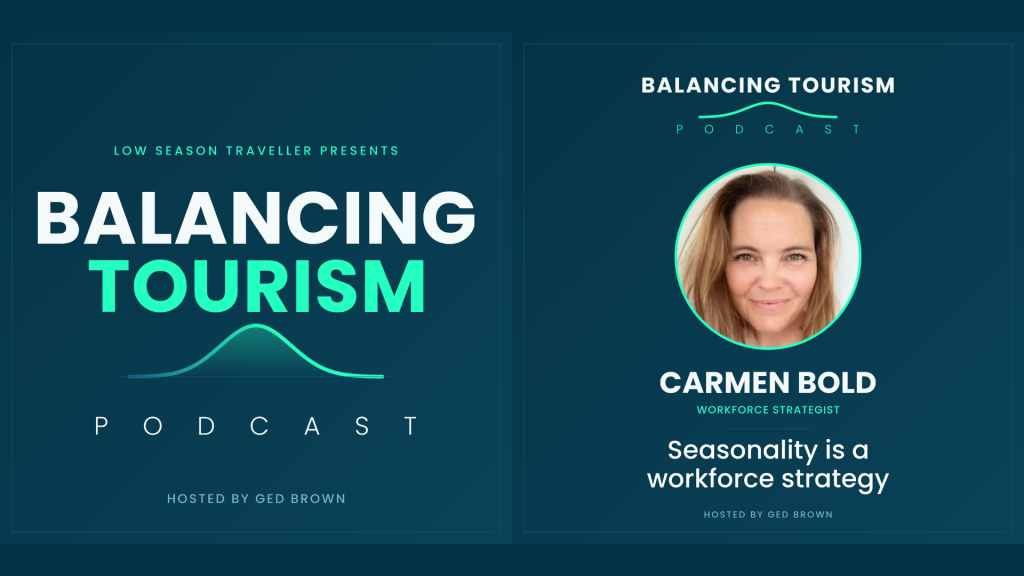
For years the tourism industry has treated seasonality as a marketing puzzle, something to be solved with clever campaigns and shoulder-season deals. A recent conversation on the Balancing Tourism Podcast makes the case that it is just as much a question of people, and that the businesses and destinations who grasp this first will hold a real commercial edge.
The jobs you never see advertised
When Carmen Bold talks about how tourism actually hires, she starts with a point that should give every operator pause. The vast majority of roles in the industry are filled through networks and personal connections long before they ever reach a job board. A manager needing a sales lead will sound out former colleagues before writing an advert, because it saves time and lowers risk. The jobs that make it onto public platforms are the tip of the iceberg.
Bold, who has spent twenty-five years in tourism and events across Australia and New Zealand and now hosts the Tourism Matters podcast, sees this as both the industry’s quiet strength and its recruitment blind spot. For those already inside, a strong network is the single most valuable career asset. For everyone outside it, and particularly for young people and career changers, that same closed system can make the industry look impenetrable and hard to plan a future around.
The commercial consequence is straightforward. If most talent moves through relationships, then an employer’s reputation and visibility as a place to work becomes a direct input into who they can hire, and how quickly.
Why people actually leave
The more striking part of the conversation concerns why people move on. Over recent months Bold has held dozens of career conversations with tourism professionals either job-hunting or weighing a change. She asked each of them the same question. Not one cited money as the reason.
What came back instead was a sense of being undervalued, of being under-resourced to the point of burnout, and of working for an organisation whose values no longer matched their own. The requests were often practical rather than financial, such as the flexibility to work from home when a child is unwell.
This points to a costly mismatch. Bold references workforce research carried out for the Pacific Asia Travel Association by Hannah Anderson of the consultancy Pear Anderson, which found a gap between what employers assume their people want and what those people actually ask for. Employers reach for flexible working, while the workforce in that study ranked a liveable wage and value alignment more highly. Firms can spend goodwill and budget solving the wrong problem entirely.
None of this removes the pay question. Bold and Ged Brown are candid that tourism remains underpaid relative to other sectors, a point made sharper in a state like Western Australia where the mining industry offers salaries the visitor economy cannot match. The strategic insight is that pay is rarely the lever people pull when they walk. Culture, workload and meaning are.
Reframing the season
The heart of the episode is a shift in how Brown thinks about his own subject. He has long approached seasonality as a marketing challenge, a matter of filling the shoulder months. Bold reframes it as a workforce strategy, and the logic is hard to unsee. Extend the operating season and you can retain your people rather than rebuilding your team from nothing every year.
That reframing raises the stakes on destination-level infrastructure. Bold argues that a seasonal workforce cannot be sustained by individual businesses acting alone. It needs destinations, regional tourism organisations, government and training partners working together on the practical foundations, starting with whether affordable housing even exists for seasonal staff. She points to Queenstown, where a housing shortage has left seasonal workers in campervans and undermined their willingness to return, and to Whistler, where a requirement to provide worker housing helps hold a workforce in place.
Where destinations choose to flatten the peaks rather than accept them, the workforce dividend follows. Queenstown repositioned itself from a winter snow destination into a near year-round one by investing in mountain biking. Tourism Tasmania’s Off Season campaign made cold weather the draw rather than the deterrent. Each smooths the curve, and a smoother curve is easier to staff.
The retention maths
For individual businesses, Bold makes the commercial case for retention in plain numbers. An employer whose seasonal workers return the following year effectively halves their recruitment, saves on training and onboarding, and keeps hard-won local knowledge in the building. A returning boat captain who knows the waterways is worth keeping on a retainer through the quiet months.
She offers practical routes to get there. Understand what each seasonal worker actually wants from their time with you, whether that is money to keep travelling or a trial run at living in the region, and manage them accordingly. Use social media through the year to build a reputation as an employer of choice, so recruitment is half-won before the season starts. Upskill people into maintenance or marketing over the low season. At destination level, look to schemes like New Zealand’s Jobs for Nature, which redirected tourism workers into conservation roles during the pandemic and kept them ready to return.
The human advantage
Underneath all of it sits a commercial argument about what tourism sells. Bold suggests the industry has a degree of resistance to automation, because travellers increasingly seek genuine human connection through people, food, music and place. That connection has to be delivered by people, and the quality of the seasonal worker greeting a guest feeds directly into reviews, repeat business and future demand. Treating workforce as a strategic asset rather than a seasonal cost is, in that light, simply good business.
For the full conversation, listen to this episode of the Balancing Tourism Podcast. And to go deeper on the numbers behind the season, the State of Tourism Seasonality 2026 Report is out now.
